


I’ve had a fascination with Rome for much of my life.
When I was a (far too young) kid, I vividly remember my dad watching Gladiator and, even from afar, just being in awe of seeing Maximus in the breathtakingly majestic Colosseum. Ever since, the concept of epic battles in that giant arena has stuck with me. Even recently, I watched Way of the Dragon for the first time and ate up the glorious Colosseum bout between Bruce Lee and Chuck Norris.
And as a teen, one of my favourite games was Assassin’s Creed Brotherhood, the second part in Ubisoft Montreal’s Ezio trilogy, because it showed me just how much more of Rome there was. I have many fond memories of just parkouring through the meticulously recreated classical architecture. Those are just a few media examples, but I could go on.
Naturally, then, I found myself eager for the opportunity to preview Ubisoft Gainz’s Anno 117: Pax Romana, the latest entry in the long-running Anno city builder series, in none other than Rome itself. While I was completely new to this genre, the historical Roman setting — both in the game and outside of it — really called to me. The idea that I could build my own version of a city that has captivated me for the better part of half my life? Sign me up!
“We knew from studies that we’ve done since a very long time that Rome has always been on the wishlist from our fans, from the community,” explains Manuel Reinher, creative director on Anno 117. “Whenever we ask them about, ‘What do you imagine for the next Anno?’ Rome was always one of the top three mentioned settings. So we took this into account. And then, of course, we did a lot of research where we dove into the topic and tried to see if it’s a really great fit for Anno and so on for the feature set that we have, but also for the core experience.”

He adds that Rome is a “powerful” setting that has an “ever-present” influence on modern society, giving the team the motivation to “find [its] own spin” on it. “That’s why we are very happy to be [set in] the Pax Romana, which is quite a stable phase. It’s peak Rome in the Roman Empire. It’s people from three continents living together,” he says. “And we found that this is a very interesting fit for us, in particular, as in our games, usually we play in different locations, and here, the provinces are a perfect link to incorporate and tell this super exciting story.”
For Reinher, that boils down to “understanding the scale” of the Roman Empire. “Usually when we think about Rome, it’s portrayed in one way, I would say, and [we want] to identify that it’s a Mediterranean Empire spanning over three continents. And in all the cultures who were united by conquerers, [they] had to somehow get along in this. And of course, there was a lot of drama — not everything in Rome was sunshine and happiness. But still, they managed somehow to live together for more than 200 years,” he explains. Anno 117 aims to explore the “connection” between those different provinces in terms of shared goods, food, technology and more.
It’s an intriguing premise that appeals to my predilection for Rome quite nicely, and knowing that you, the player, will play an active role in shaping it only makes it more fascinating. In Anno 117, you assume the role of a governor who’s been appointed to oversee the expansion of the Roman Empire into the aforementioned three provinces. After choosing your starting locale, you’ll set out to begin construction of small settlements that will, in time, give way to expansive cities, all while managing your population’s health, safety and happiness.
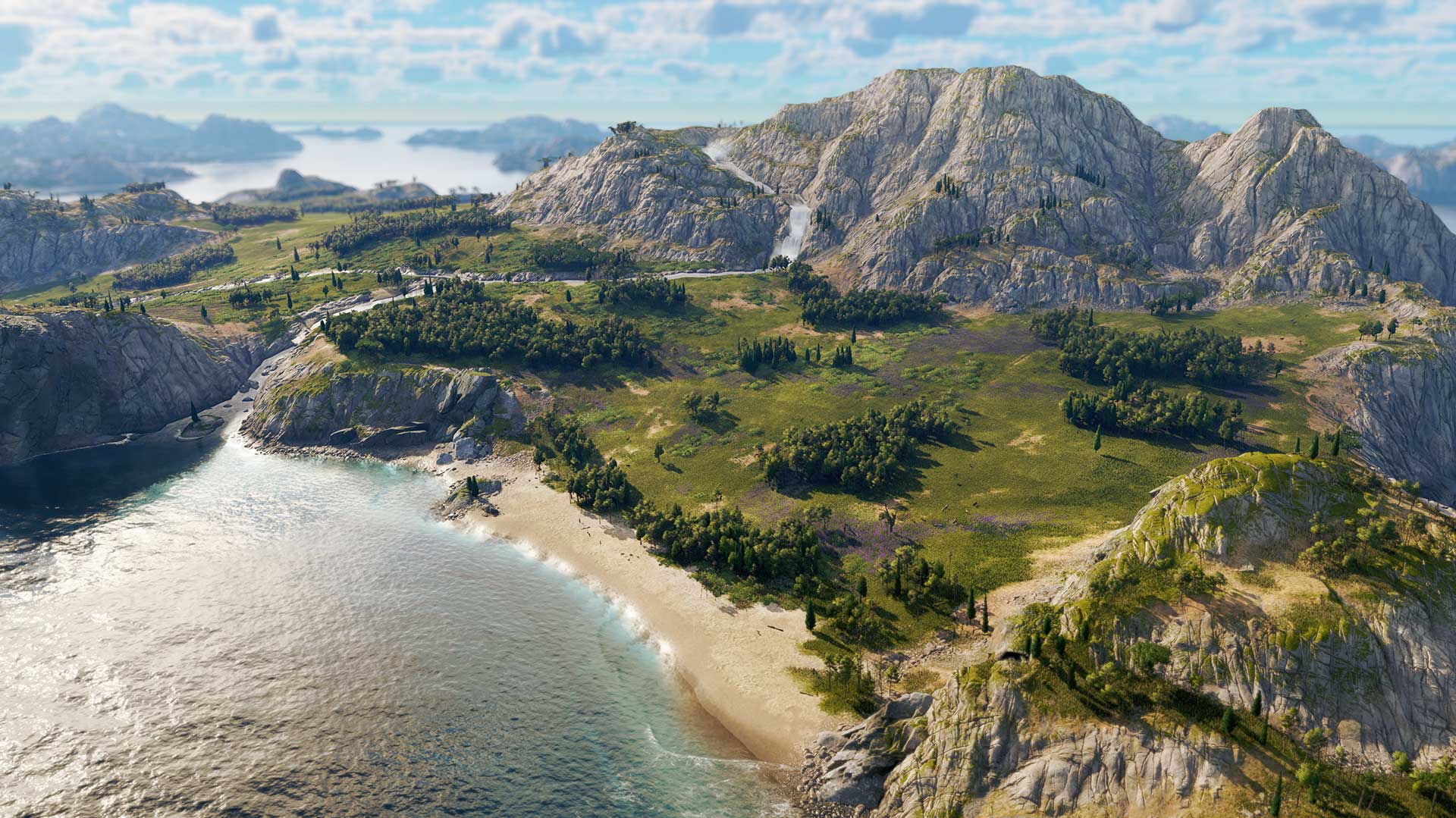
Having never played a city builder, I’ll confess that I found it a bit daunting at first. There’s a lot to parse through very quickly from the litany of menus and their corresponding options. Seeing all of that juxtaposed with this empty plot of land led me to freeze up for a moment. “What do I do?” I asked myself.
Thankfully, that’s where one of the new features of Anno 117 comes in handy: an advisor who steers you in the right direction. If you’re feeling lost, as I was in this moment, you can click on his icon and he’ll outline some things you should do. In this case, it was starting building a production pipeline that included a sawmill, warehouse, and trading post. The components to build each construct were listed, and I could spend the allowance the emperor had provided me on manpower and materials. Before long, I had myself a little network of buildings.
As Reinher notes, the team made “quite some investment when it comes to onboarding,” which resulted in the advisor. “We have many more elements than we’ve ever had to help the onboarding process — importantly, though, without losing the complexity of the game. Because we want to embrace the rich feature set that we have. So this is one important step that we had.”

He notes that the previous Anno game, 2019’s 1800, was the first mainline entry to come to consoles. This gave the team a strong starting point to build a console version — and, through that, extra onboarding tools — for a new Anno game from the ground up for the first time ever.
“Now, it’s bit more easier actually to integrate,” says game director Jan Dungel. “It’s more about the user interface — more about how you actually navigate through the features and so on. That had to be remapped to some extent, but we didn’t have to change the gameplay features. For example, if you had different content in the console version, or that you would have some features that would need to be removed or [implemented] differently.”
With all of that said, there were some onboarding elements that just weren’t ready for this demo, as one Ubisoft representative mentioned to me while I played. I also ran into a known bug in which spending money to upgrade a building didn’t work, meaning repeated taps on it would simply cause you to lose funds each time.
Other than those understandable minor issues, much of the game, at least at first, is a bit of trial and error, and I found myself appreciating that. For instance, I quickly discovered that I had to create paths between each building that connect everything to the warehouse and trading post. I also eventually realized, as my town got bigger, that there’s a limited radius within which goods can be moved from each building. I appreciated how all of this challenged me to be more conscientious of where I was placing architecture and knowing when to relocate or even demolish each piece as needed.

Creative director Manuel Reinher (left) and game director Jan Dungel (right).
I also soon came to admire just how many interlocking systems there are. For instance, each building can have various attached attributes, including Happiness, Knowledge, Research and Income. Catering to the specific wants and needs of each building’s inhabitants will raise these attributes and, in turn, improve their productivity and the taxes you collect on them. This could mean one batch of homes might want a certain type of fish, leading me to set up a nearby fishery, but then that fisherman might need bread, which requires constructs like oat farms. Essentially, it felt like one big puzzle consisting of many smaller ones, and I enjoyed picking at them one at a time.
Greater complexity came in the form of new types of citizens that I could welcome in who were more efficient but also more expensive to manage, as well as essential structures like medical buildings, fire stations and sheep farms, and beneficial places like taverns to boost Happiness. Even in just an hour of playtime, the progress I was making was tangible, and it made me really start to understand why people like these sorts of games. You’re playing “God,” in a sense, but also with all of the responsibility that should entail. There’s really no other feeling like that in games.
I will say, however, that I do wish there was a way to play around with all of this without impunity. That’s because I was operating at a loss for a good while, with my tax revenue being outweighed by excess expenditures. Seeing my funds continuously in the red proved a bit more stressful than I’d like, especially since I was still finding out what I was doing. To Anno 117‘s credit, the emperor does bail you out once with the 10,000 gold (a generous sum at this part of the game), but after that’s gone, it’s game over. In any case, some kind of more guided tutorial mode in which you didn’t have to worry about money would be most welcome. (It wasn’t clear if this is one of the onboarding features in the works.)

That said, part of this was no doubt a me problem, as two of the journalists in my group who were also new to city builders had already been off to new islands and operating in the green. And if nothing else, it would have still taken a while for me to go bankrupt and lose, so I would have still had, in theory, plenty of time to recuperate.
That’s ultimately the message that the developers wanted to leave players like me.
“Take your time. It’s not a game that you should rush. Usually, Anno is about slowing down a bit and trying out certain things. There is no immediate action or reaction that ruins everything. Observe the world, observe the statistics, and just approach it step by step. It’s a game that’s relaxing — it’s a huge, immersive world that you can dive in,” says Reinher.
“Explore! It’s quite welcoming, in a sense, that you might feel the sense of accomplishment. You don’t need to understand the full picture. For example, just build a lumberjack. It’s already in the tasks. Enjoy the task. You see that actually, the lumberjack is working and slowly building up,” adds Dungel. “That’s really the advantage of Anno, that you can do it step by step. Yeah, maybe you will come into problems. Maybe you want to try again. But I think that the knowledge is coming step by step, and it’s not about having this full picture and understanding the whole universe before you can dive into the game. It’s really rewarding in these small steps.”
I can definitely see what they mean in my time with the game. Having even a little town established, creating interweaving paths through it and seeing my little denizens walk around is genuinely neat. I was also impressed by the fidelity of it all. You can adjust your POV at any point, and I was surprised at how close to the ground you can pull the camera, giving you an even closer connection to your people.

And of course, knowing that this is only the beginning is especially tantalizing. Before the hands-on demo, we saw a gameplay trailer showing different takes on the bustling ancient Rome that’s become so iconic, and it got me excited to eventually build up to that point. The promise of other mechanics, like trading with other settlements, managing my armies and, of course, constructing my own Colosseum, only adds to the appeal. Getting to see some of Rome itself during this trip, including the Colosseum, Vatican and Roman Forum, has me genuinely excited to bring them to life in the game.
Thankfully, I won’t have to wait much longer to do that, as Anno 117: Pax Romana launches this fall on PS5, Xbox Series X/S and PC. Until then, I’ll be dreaming up my perfect version of Rome.
Image credit: Ubisoft
MobileSyrup may earn a commission from purchases made via our links, which helps fund the journalism we provide free on our website. These links do not influence our editorial content. Support us here.

