


My history with the Dying Light series is sporadic, at best.
While I’ve played both of the original games, it was during limited library rental periods, so I fell off of both. That said, I always liked the core premise of being thrown into a zombie-infested sandbox and having to use parkour and melee-combat to survive. All of that is to say that I was rather intrigued going into my four-hour hands-on Dying Light: The Beast preview.
It’s a smart approach for a new entry, too, as it follows original Dying Light protagonist Kyle Crane as he seeks vengeance against a mysterious baron who had conducted horrible experiments on him for 13 years. In this way, long-running Dying Light fans get to catch up with an old friend, while the significant passage of time means that newcomers and those who only dabbled with the original game can jump on easily. All you really need to know is Crane is understandably pissed, and returning voice actor Roger Craig Smith brings that fearsome edge to the character.
My demo also began after the roughly one-hour introductory level in which Kyle escapes, so that leaves some narrative intrigue surrounding what I’d assume was a pretty intense sequence. On the flip side, it also means that I didn’t get a feel for the Baron himself. He came up a lot throughout the entire preview, with one early ally that Kyle meets, Olivia, explaining that he’s basically a smarmy biotech company nepo baby. But I still never actually got to see him, which lessens the impact a bit of the revenge angle so far. Hopefully, he proves to be a commanding screen presence in the final game.
The Baron’s influence can, however, be felt more directly in the gameplay. That’s because the titular “Beast” is none other than Kyle himself — an unfortunately by-product of his time as the Baron’s lab experiment. This means that Kyle has a version of a “rage mode” that allows him to rapidly move and deliver powerful punches. At some points, he’ll even tear limbs straight off zombies. It’s a fun way to turn the tables against hordes or even a lone heavy after treating them with caution. At first, you can’t control the transformations, with them being triggered automatically after a bar is filled, but enough progress through a dedicated Beast skill tree will let you enable the mode at will.

To balance this system, the only way you can earn Beast skill points is by beating unique “Chimeras,” which are more advanced zombies that can come in such forms as Hulk-like brutes or fast-moving bloody skeletons. These encounters are tense and frenetic, especially with the latter Chimera. In one story mission, I tracked the monster to a fog-covered islet and had to repeatedly avoid its acidic bile projectiles by hiding behind a partially submerged bus and taking out grunts it was sending towards me. Using the resources they dropped, I could craft useful items like bandages or even a molotov to lob at the boss once he jumped atop one of his grunts.
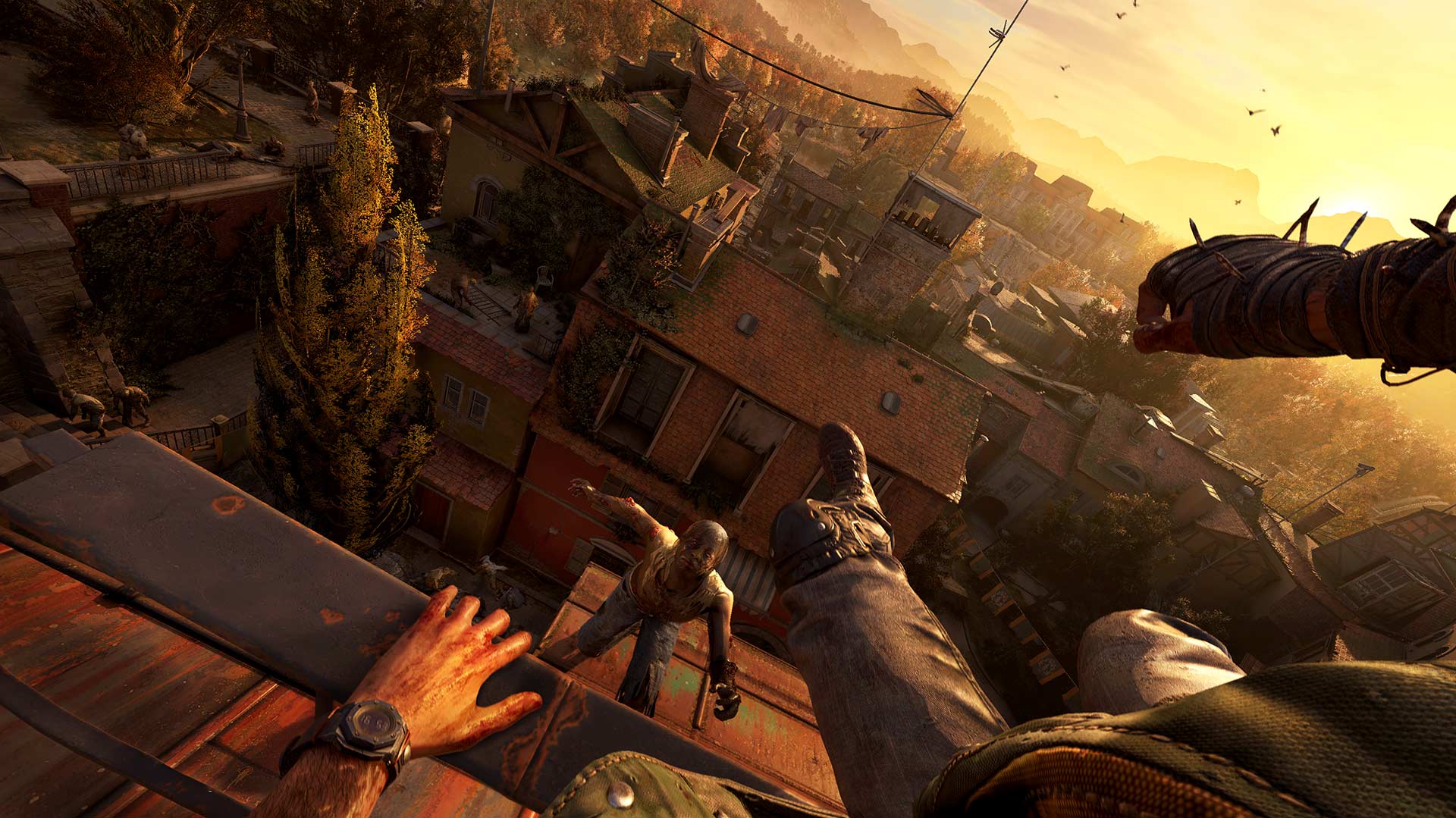
It will definitely be worth seeking out these Chimeras, though, beyond the challenging-yet-thrilling fights, as some of the skills on the Beast tree are very tantalizing. I was especially intrigued to eventually unlock an ability that lets the Beast carry out tall leaps, which should bring an interesting wrinkle to Dying Light‘s signature parkour. But even as human Kyle, it’s still a blast to be in a city and jumping between rooftops, dancing and weaving between the occasional zombie that managed to make it up there while using poles, cables and ledges to stop yourself from plummeting to the streets. It’s an exhilarating feeling, and still the best part of Dying Light.
On that note, parkour perhaps feels even more impactful this time around given the nature of the game’s setting. That’s because The Beast takes place in Castor Woods, a popular tourist attraction that has plenty of rural forested areas surrounding more metropolitan locations. This means you can’t just vault up to a tall building in a sticky situation; you have to be more thoughtful about charting your path and looking for trees, fallen vehicles and other objects that provide precious elevation in otherwise less populated areas.
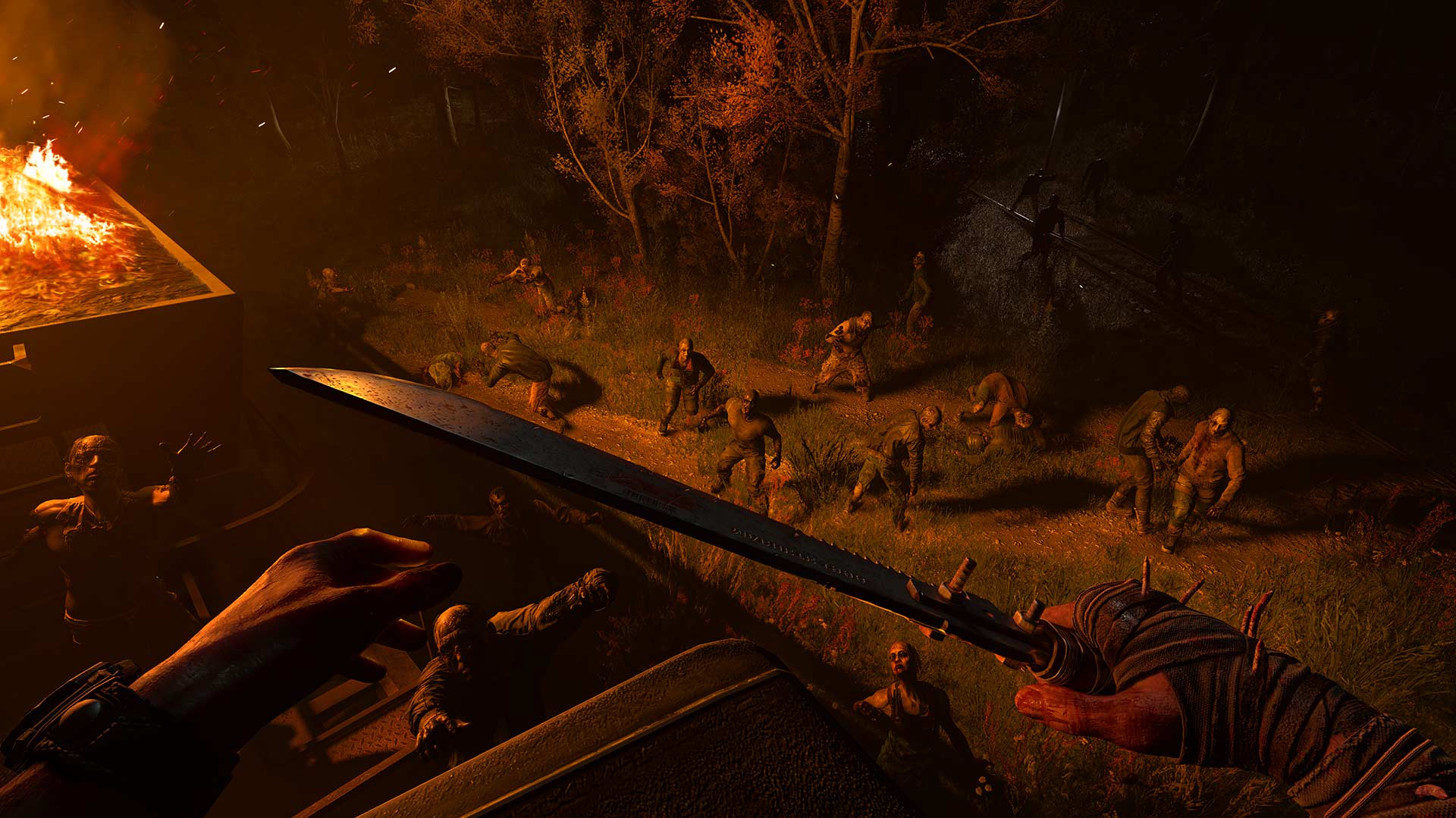
This is particularly important because Dying Light‘s core day-and-night cycle returns, bringing with it more deadly zombie variants once the sun has set. As with the previous games, this does give you the opportunity to get better loot in a smart risk-reward set-up, but naturally, the dangers are even higher if you’re out in the middle of nowhere. This is where off-road vehicles come in. With no lights at night and a GTA-esque progressive “wanted” system with zombies, you’ll basically be committing suicide if you go out without a vehicle. Of course, they’re not always easy to come by or maintain, with zombies jumping onto your windshield and roof to hammer away at its health or fuel running low.
It certainly adds to the survival feel. In one instance, I managed to make it out alive at night in the woods by coming across a tall treehouse that I could ascend and turn into a safe house. In another situation, I came across a small house with a big brute in the backyard, and I took him and his posse out by igniting and throwing propane tanks while avoiding a blown electrical fuse that had supercharged him. This, too, rewarded me with a safe house containing tons of loot. The treks between safe places makes plotting your routes feel purposeful and rewarding, especially when considering the impending dusk.
This is improved by the fact that the game has a meaningfully sized world that feels dense rather than just being large for the sake of it. That graciously reined-in scope can likely be attributed to The Beast‘s origins as a Dying Light 2 expansion. Overall, Techland promises an experience that is shorter than the other Dying Light games, and that’s refreshing in the day-and-age of bloated hundred-hour open-world fare. It challenges you to engage with more of the world instead of skipping over large portions because it’s just too big.
With that said, Techland confirmed to me that it made a conscious choice to not include fast travel. While I can appreciate the vision behind that, intending you to have to plot your routes each time, I’m still not a fan of repetition when it could have easily been avoided. In particular, there was a part of my demo where I was dealing with the people in the main city’s church and then Olivia called and told me to first return to the monastery I met her at, which is quite a ways out into the forests. After I did that, I had to go back to the city to resume my business with the church dwellers. It felt like needless backtracking that could have easily been mitigated with fast travel or even reworking that quest structure. It’s not a major issue, but I would have at least appreciated the option.
As I wrap up, I also want to shout out perhaps the highlight of my demo, which was a sidequest involving a man in the church named Eli. He asked me to look for his elderly father, who has dementia and wandered off, knowing that Kyle is more capable. What made this interesting, though, is that Eli actually resents his father for years of neglect (something I could absolutely relate to), but still wants to save him since he says leaving him to die would make him “no better” than the zombies.
I won’t spoil the outcome of the quest, but it culminated in me visiting Eli’s father’s home and an adjacent cave network to uncover a surprisingly sinister bit of world-building for the broader story while also adding interesting shades of grey to the family patriarch. I hope more of the quests in the game carry similar narrative meat, because I thoroughly enjoyed that entire subplot.
That’s ultimately what I’m taking with me out of the preview. The new Beast Mode and rural sandbox are solid, but I’m most eager to use those mechanics for that satisfying mix of loot and sidequest discovery. Hopefully, it all comes together in a strong way.
Dying Light: The Beast will launch PS5, Xbox Series X/S and PC on August 22, with PS4 and Xbox One ports coming in late 2025.
Image credit: Techland
MobileSyrup may earn a commission from purchases made via our links, which helps fund the journalism we provide free on our website. These links do not influence our editorial content. Support us here.

