


A new report outlines the many benefits that games offer to those who play them.
Dubbed the Power of Play, the report was conducted by AudienceNet on behalf of the Entertainment Software Association of Canada (ESAC) and global partner organizations representing 20 other countries across six continents. For the report, AudienceNet surveyed 24,000 gamers to learn about their gaming habits and why they enjoy playing games. In Canada, a total of 1,521 people were polled, 514 of which were in Quebec and reported separately.
“It’s a data-driven reminder that video games are, of course, fun, but so much more,” says Paul Fogolin, president and CEO of the ESAC, of the report. “People play games to help their mental health and well-being. People play games [for] a sense of community and a source of belonging. They also find that it helps with cognitive skills and brain development. All of those things are part of the play experience, aside from just playing for fun.”

Image credit: ESAC
Demonstrating that is the fact that not only do 72 per cent of Canadian gamers say they play games to have fun, but a majority of them also report games have affected positive change in their lives. This includes 68 per cent of Canadian respondents saying games provide a healthy outlet from everyday challenges, 70 per cent reporting that games make them feel happier and 80 per cent play for stress relief and relaxation. Moreover, 57 per cent even noted that games helped them get through difficult periods in their lives.
“This isn’t like one in three. This is more like 2 in 3. These numbers are high,” says Fogolin. “If you were to tell somebody that they can get a prescription for something, let’s say a medication, that says, ‘There’s a 70 per cent chance this will make you feel less anxious, it’ll help you with your anxiety, it’ll help you with your stress,” you’d say, ‘Great! Where do I sign up?”
While ESAC and its global partners also published a Power of Play report in 2023 with similar findings, Fogolin notes that the 2025 edition includes many additional data points. For instance, Power of Play 2025 shows that 51 per cent of Canadian gamers are actually women, versus 49 per cent for men. (Less than one per cent of respondents selected “non-binary” or “prefer not to say.”) One top of that, 37 per cent of respondents were aged 35 to 54, while 35 per cent were 55+, with the 16 to 34 demographic accounting for 27 per cent.
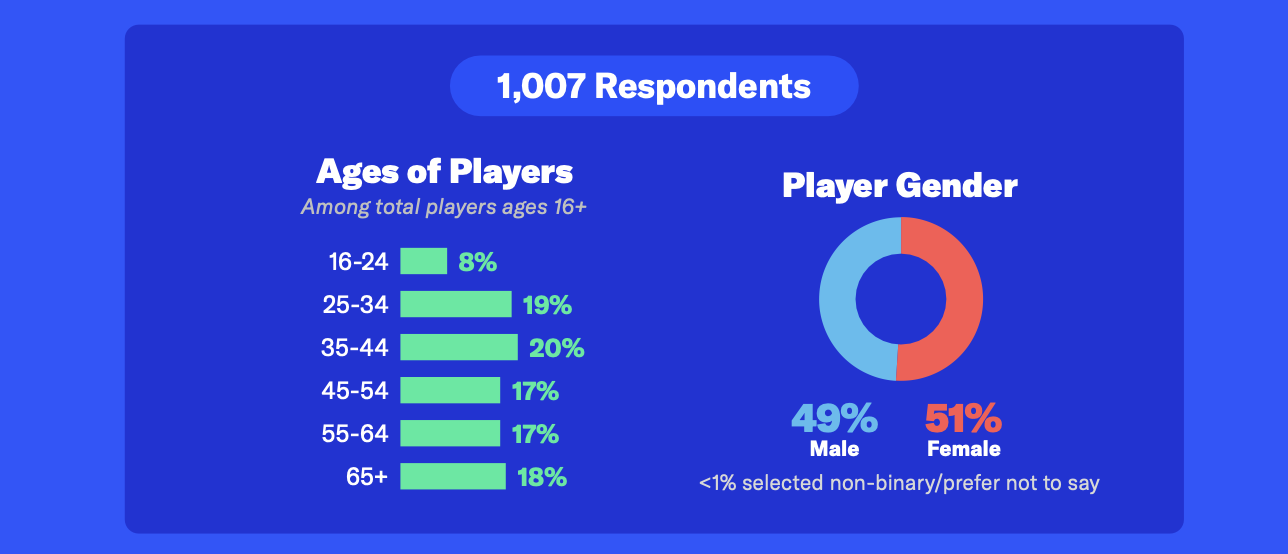
Image credit: ESAC
Altogether, this data helps dispel long-running misconceptions of gaming being predominantly for young boys. A key reason for that is no doubt the variety of gaming devices on the market. As the report shows, 52 per cent of Canadians play on mobile, making it by far the most popular platform and one that undoubtedly appeals to all kinds of players. Meanwhile, 25 per cent of Canadians are playing on consoles, 22 per cent are gaming on PCs and about one per cent are using VR headsets.
This year, the Quebec data is listed separately from the rest of Canada, which is a change from the 2023 report. Fogolin says ESAC specifically requested that this due to the province’s “rich video game culture” as it’s both the country’s primary hub for game development and one of the largest in the world, period, as well as the cultural and language differences.
While he notes that the data is broadly comparable between Quebec and the rest of Canada, there are some interesting differences. For instance, 58 per cent of Quebecers play on mobile, six per cent higher than the wider Canada, while 53 per cent of the province’s gamers are women, two per cent above the national average. “It is neat to have have the data available for those data geeks who want to dive in and kind of say, ‘Oh, what’s the difference? I wonder why?’ And start to do a little bit of digging.”
Another insightful aspect to the Power of Play report is the context for how Canada compares to all of the other countries. In that regard, there are some intriguing differences. Arguably the most notable is that Canadians’ favourite game genre was puzzle with 59 per cent, above the 50 per cent global average. (Rounding out the top 3 genres were “action” at 39 per cent and “skill and chance” at 30 per cent.)
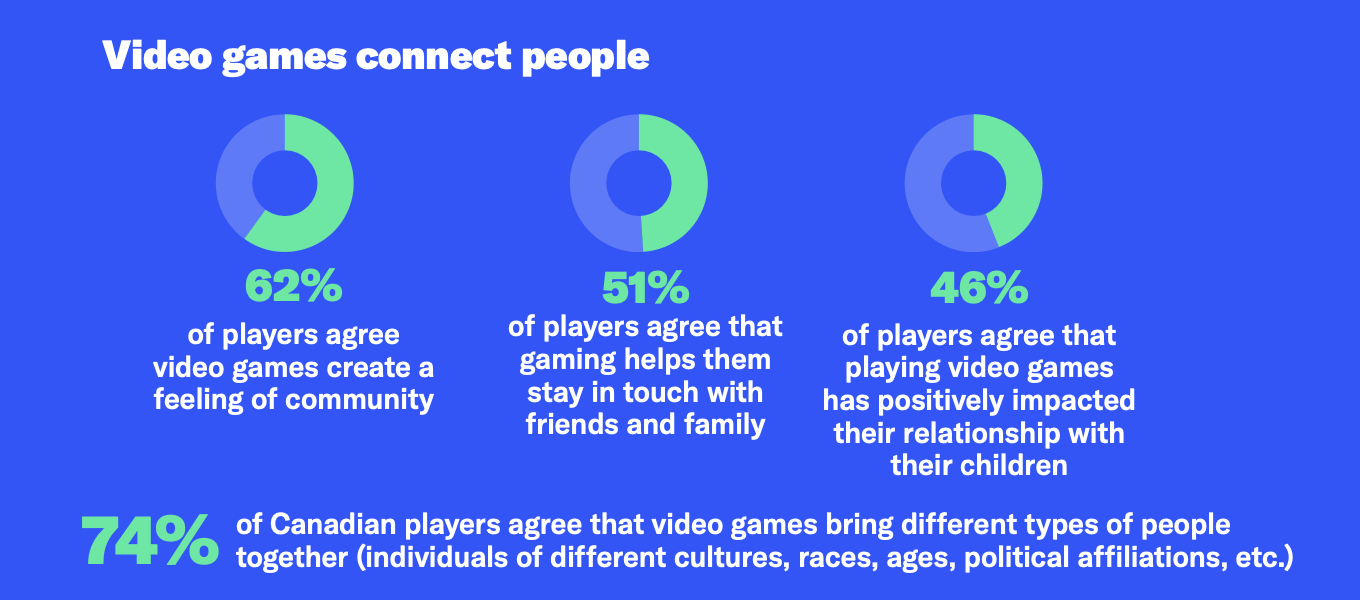
Image credit: ESAC
But ultimately, Fogolin says what he keeps coming back to is how the report shows the unifying power of games.
“Seventy-four per cent of players in Canada think video games can unite by bringing different types of people together, which, in this time more than ever, where can you find an area where people of all sorts of diverse backgrounds can get together and have fun?” he says.
To that point, he notes that 51 per cent of players use games to stay in touch with loved ones, while 43 per cent of players have actually met a good friend or significant other through games. “The 43 per cent one really jumps out because although it might seem low, it’s less than 50. That’s not staying in touch and playing with current friends; that’s brand new people. That’s people you didn’t know before you started playing a video game. That’s a powerful point.”
This is the message he hopes for the Power of Play report to convey to people, especially as there continues to be a lack of mainstream understanding about games.
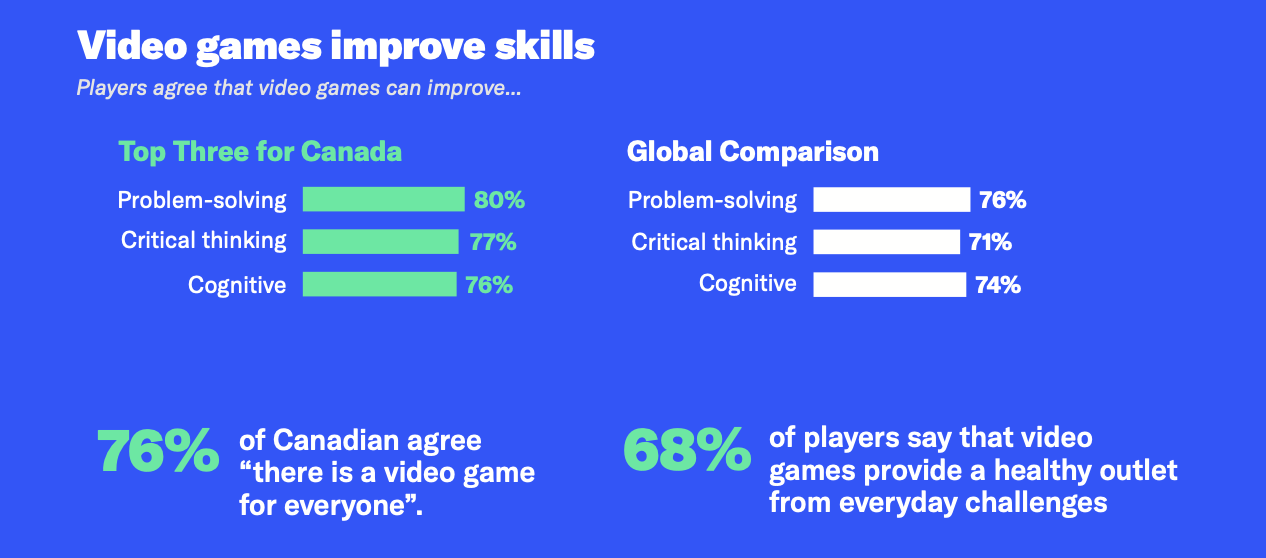
Image credit: ESAC
“Unfortunately, there are still negative narratives out there. There’s sometimes a lack of education about games not necessarily being this positive force, and that’s why we need to keep doing this work and reminding people, ‘Well, actually, not only are games amazing fun, the best form of entertainment, the most profitable entertainment industry in the world, but by the way, they’re also great at connecting people, and they’re great at helping you with your mental health and all these things,'” he says.
“So we keep having the conversation, and hopefully one day, maybe in the distant future, when I’m no longer in this role, that we won’t have to do this kind of stuff anymore. But it’s important to keep these conversations happening.”
The full report can be viewed on ESAC’s website.
It’s worth noting that the Power of Play report comes during the ESAC’s celebration of its 20th anniversary and Canada’s broader $5.1 billion gaming industry. As part of that, Vancouver-based Next Level’s Luigi’s Mansion 3 won The Great Canadian Game-Off contest that ESAC hosted in partnership with MobileSyrup. Fogolin says he’s had people, including a lifelong friend, tell him they didn’t know many of the games featured in that campaign were Canadian.
“That was part of the reason to do this — not not only to celebrate for those who were involved in making the games and those who are aware of these games being made in Canada, but I know that there’s a lot of people, like my friend, who didn’t know that. How cool is that? I could almost see in his face this sense of pride,” he says.
For the next part of the campaign, Fogolin teases a series highlighting veteran Canadian game developers. He also says he’s looking forward to seeing what Canadian games might be honoured in the likes of The Game Awards, especially after last year’s Saskatchewan-made Balatro was such a smash hit.
“We’re going to keep the conversation going, and we’re going to keep engaging the fans and engaging with the creators across the country to tell our story, to learn more and to keep growing.”
Header image credit: Shutterstock
MobileSyrup may earn a commission from purchases made via our links, which helps fund the journalism we provide free on our website. These links do not influence our editorial content. Support us here.

