


Qualcomm’s modem hardware outperforms Apple’s C1 modem used in the iPhone 16e, according to the results of a new study commissioned by Qualcomm.
Cellular Insights put together the study, which compared the 5G performance of the C1-equipped iPhone 16e to two unnamed Android smartphones. The first, dubbed ‘Android A,’ was a 2025 flagship with Qualcomm’s Snapdragon X80 modem, while ‘Android B’ was a 2024 flagship with the X75 modem. The tests were performed in New York City using T-Mobile’s sub-6GHz standalone 5G network.
Notably, the iPhone 16e is the first to sport Apple’s in-house modem, with previous iPhones using Qualcomm modems (or even Intel modems if you go back far enough). With Apple trying to move away from Qualcomm’s modems, it’s no surprise the company is serving up reminders that its tech is better.
And while that makes for a good headline, the actual report clarifies that “while all three devices delivered somewhat comparable 5G performance under ideal, near-cell conditions, performance deltas became increasingly pronounced as signal conditions deteriorated.”
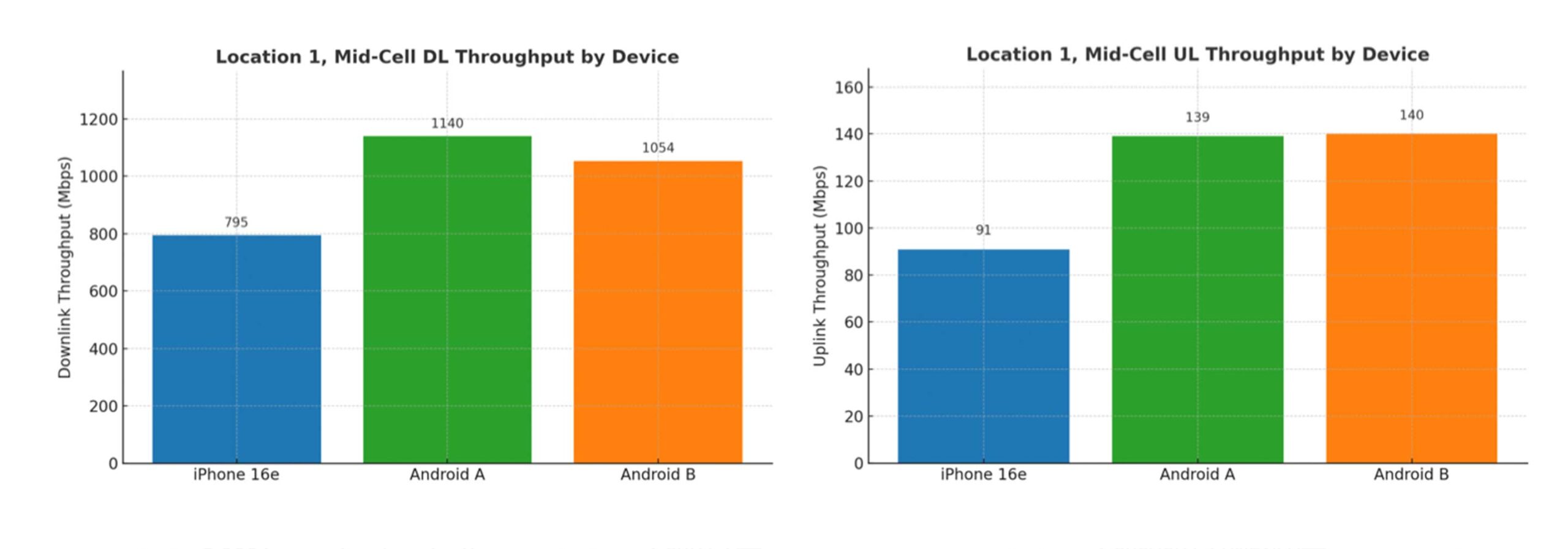
Qualcomm’s test results in the best-case scenario.
Which is to say that most of the time, the C1 and the Qualcomm X75 and X80 modems will perform more or less the same. It’s edge cases where Qualcomm can provide more of a lead.
Even in these edge cases, this doesn’t mean the iPhone was unusable; instead, it just got slower than the competing Android devices. In the below graphs, you can see that the slowest the iPhone 16e got during the testing was 228Mbps down and 5Mbps up.
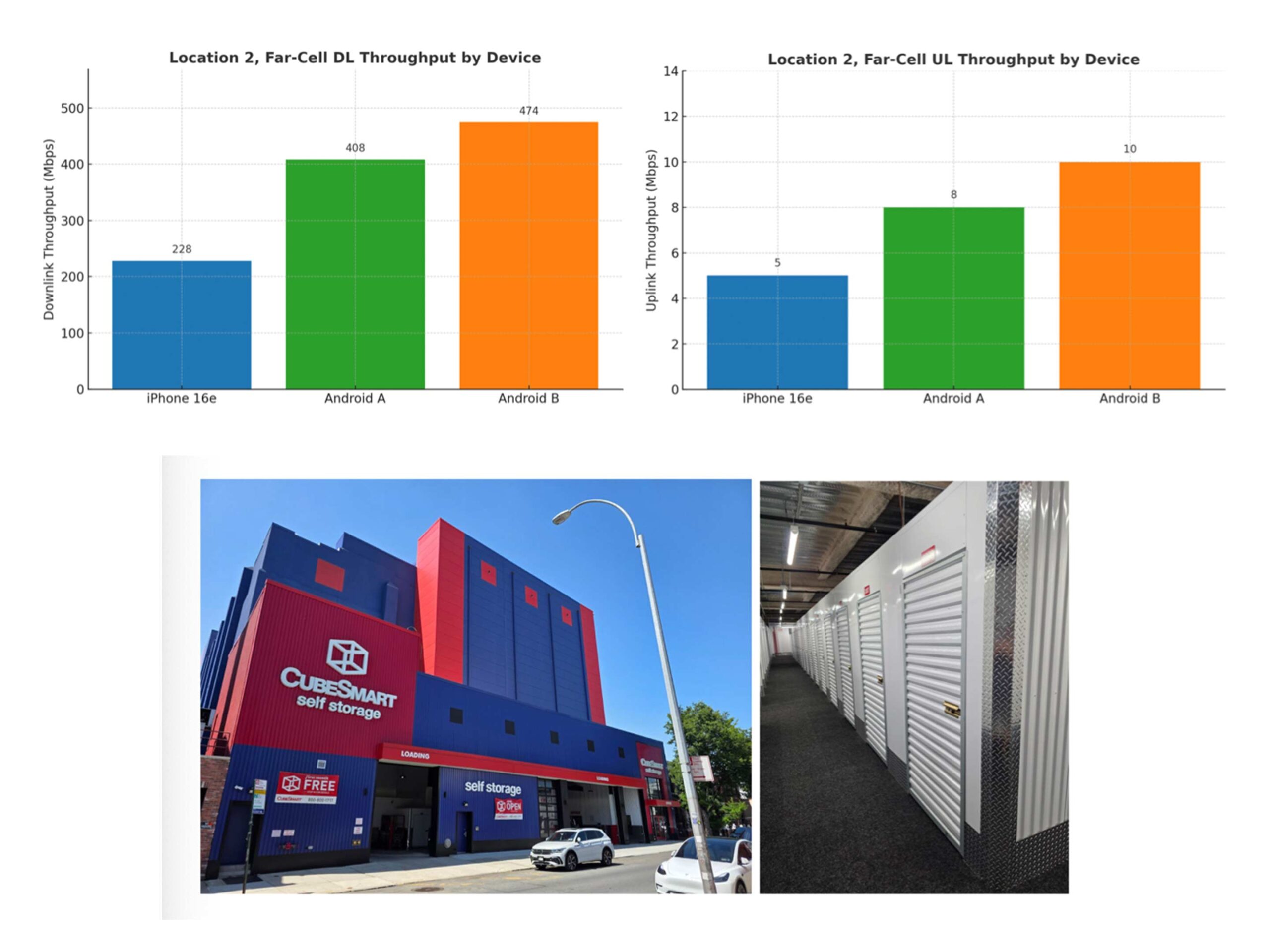
Edge case test performed inside a storage facility.
These aren’t great results, but I’d argue that 200Mbps down is likely fast enough for anything you’d want to do on a phone. The best Android handset was also only getting 10Mbps up in the same test, so both are pretty limited for uploads. (Not to mention that most Canadian providers cap wireless speeds, often at around 250Mbps.) This test was also taken inside an urban storage facility, so the phones were surrounded by metal and concrete, which is a worst-case scenario for all devices.
The report goes on to mention that using the 600MHz N71 bands can improve Android’s modem upload performance to 23 Mbps. However, the phone had to be manually configured to take advantage of this slice of spectrum, so it’s not exactly a huge win for the average person. However, it does speak to how network optimizations can make a big difference in today’s multi-band networks.
More to consider than just speed
Overall, you can look at the charts in the full report and draw your own conclusion, but to me, all three modems are more than enough. Most users don’t really pay attention to network speeds anymore since everything is fast enough.
I’d take the battery life and efficiency improvements of the Apple C1 modem over the top-end speeds Qualcomm is touting. Sure, it would be great to get maximum speeds all the time, but the most bandwidth-intensive thing I do on my phone is watching YouTube, so anything above 50Mbps is usually fine. What does make a difference in my life is getting some extra battery life so I can watch content longer, which is the issue Apple is trying to solve.
However, the nuance goes a bit further. While the report doesn’t specify which Android phones it tested, the Android A device with the X80 in the report is listed as a flagship that costs US$799, making it highly likely that it’s the Samsung Galaxy S25. This is more expensive than the iPhone 16e, but it does have better battery life, even with the Qualcomm modem. Both phones have roughly 4,000 mAh batteries as well.
There is precedent that as Apple moves to the C2 and C3 modems over the next few years we’ll start to see more parity between Qualcomm and Apple, but for now, if you want the best speeds you’ll likely want a phone with a Qualcomm modem which will be Andoids or even the iPhone 16 Pro.
Side note: While not exactly related to cellular modems, some Android phones will get better Wi-Fi 7 speeds if you have a super-fast home network. For some reason, Apple hasn’t implemented Multi-Link Operation (MLO) on any of its devices, which means it’s stuck on Wi-Fi 6E bands. MLO allows devices to connect to multiple Wi-Fi bands (2.4GHz, 5GHz, and 6GHz), which can increase speeds.
Not all Android Phones support this feature, though. For instance, the Pixel 9 line does not, while the Galaxy S25 line does.
Source: Cellular Insights
MobileSyrup may earn a commission from purchases made via our links, which helps fund the journalism we provide free on our website. These links do not influence our editorial content. Support us here.

